
My home state, Utah, is packed with law-breakers, scofflaws. They do it with impunity, on a daily basis. To make matters worse, law enforcement is complicit.
It’s illegal to drive faster than the speed limit. Utah takes this very seriously; the penalty is not trivial. Anywhere from just 1–10 mph over the limit starts with a base fine of $130. Criminal and security surcharges are added depending on the jurisdiction, pushing the cost north of $200. Obviously you get points added to your license, raising the cost of car insurance. You can do traffic school in some cases to remove the points but not the fine. In fact, traffic school adds to the final bill. All just for going 1 mph over the limit!
Despite the severity, what I described is not how it really works. The way it really works is that 95% of the cars on I-15 (Utah’s primary freeway) drive 5–10 over the speed limit. It’s arguably more dangerous to drive at the speed limit or below because of how it disrupts the flow of traffic.
Not only that, the Utah Highway Patrol is complicit in the daily law-breaking. You will definitely not be pulled over for driving 5 mph over, and rarely for driving 10 over. The much likelier reason you get pulled over for speeding is, again, based on the flow of traffic. I haven’t had a speeding ticket in well over a decade, and my last one was in Nevada, not Utah. I pretty much exceed the speed limit at some point every single day.
I promise not to end this essay by arguing that breaking the law is okay. I have a different point to make.
This past spring semester, Brown University’s economics professor, Dr. Roberto Serrano, gave his students a take-home midterm exam for his Welfare Economics & Social Choice Theory class. This was outside his normal practice of in-class exams, but students had expressed fear of being gathered in person because of a recent shooting and Prof. Serrano relented. In fact, two of his students were among the wounded. One who died had asked him just days before to be her academic advisor.
As for the results of the take-home exam, Inside Higher Ed explains the predictable outcome:
But by the end of the semester, Serrano regretted the decision. Dozens of students in the class likely used artificial intelligence to cheat and earn perfect or near-perfect scores on their midterm, he said. Serrano in turn made the final exam in-person, which led more than a dozen students to drop the course and even more to fail it. Administrators’ response to the widespread cheating event has been “meek,” he said, and the incident has raised questions about how universities can—and should—respond to AI-enabled cheating at scale.
From the article we learn that Prof. Serrano forbade students from using AI on the exam; it was closed-book. But there was no proctoring or other enforcement mechanism. Students were entirely on their honor.
In past semesters, the typical score on this exam averaged from 65 to 80 out of 100. For this midterm, the average was 96. These are the students’ midterm scores compared to their final exam scores, screenshotted from the article.
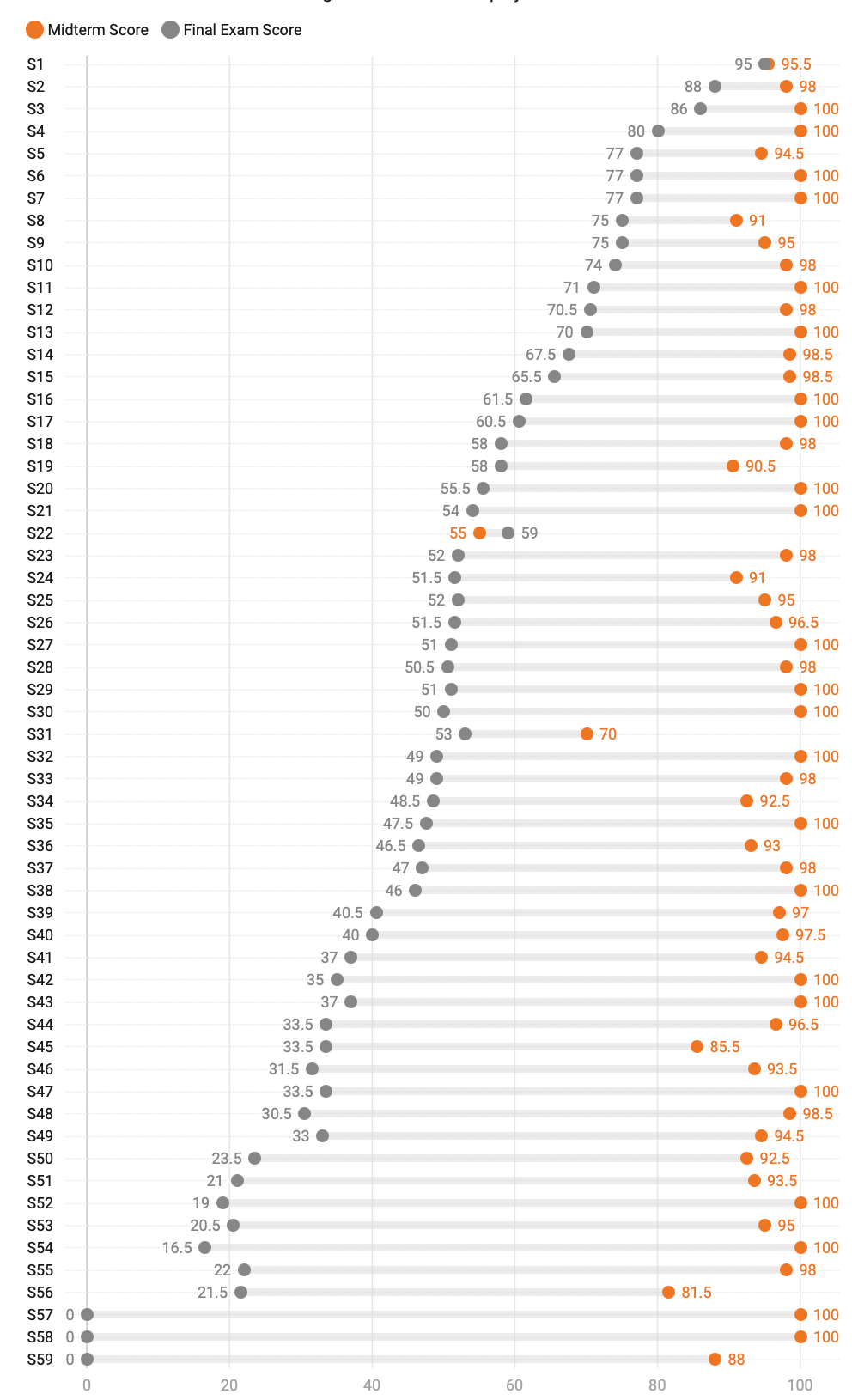
Given obvious cheating, it was smart and fair for Prof. Serrano to offer the final exam as a proctored alternative. He also lowered the required score to pass the class, but 18 students ended up dropping and 19 failed the class. It was an academic disaster. To make matters worse, Brown’s administration took a page from Highway Patrol and basically looked the other way. The story gives more detail, but the cheaters got away without further consequences.
The resulting public attention has been, essentially, a chorus of people lamenting both the harms of AI and a total lack of moral character in present-day college kids. I see it differently. I think Prof. Serrano, Brown University, and modern-day education share some of the blame.
I promise not to end this essay by arguing that cheating in school is no big deal. I have a different point to make.
And here’s where I must admit that I somewhat mistreated my fellow motorists by calling them all scofflaws. You see the law in Utah specifically requires driving at a speed that is “reasonable and prudent under the existing conditions,” for which a speed limit can be used as prima facie evidence. That is, driving at unreasonable and imprudent speeds is what’s actually illegal. The speed limit is there as one of multiple benchmarks. All of this means that a highway patrolman may watch me cruise by at 5-over the speed limit and judge that my driving is prudent enough, not a violation of the actual law.
In fact, what many don’t know is that speed limits are set by a process that includes observing the natural flow of traffic on a roadway, used as a guide for what drivers consider to be safe. After all, as long as they can judge the danger accurately, people don’t drive at a speed that puts themselves or others at risk. Not all drivers work that way, but most do.
This standard, though, is not always applied to every roadway. Near my house is a wide road on a steep hill, and a speed limit of only 25 mph. It is unreasonably slow. In fact, you have to aggressively downshift or ride your brakes to stay at that speed. Everyone goes faster, because going faster is not imprudent. But it’s technically part of a residential area, defaulting to 25, even though the homes there are more spread out and set back further from the car lanes.
There is always a degree to which speed limits are arbitrary. I expect that you now see where I’m going.
Here’s a non-exhaustive list of reasons why students consider it okay to use AI to cheat:
- The class doesn’t cover knowledge needed for their careers, so actually learning it isn’t needed. (Take that, economists!)
- Everyone else is doing it, putting a non-cheater at a disadvantage.
- The demands of a heavy semester mean some things need to be sacrificed.
- In the immediate future, we’ll all use AI every day for knowledge work, so why not use it for schoolwork.
Notice that the last justification is new and, more importantly, true! The future of knowledge work will involve regular and consistent use of AI, at a minimum as widespread as the historical adoption of calculators and then personal computers.
Also worth noting is that the second rationalization for cheating—that everyone does it—isn’t true. This study by Sam Illingworth and others showed that (at least in the UK and Australia) the vast majority of students do not habitually cheat with AI and:
the habitual cheaters who use GenAI most of the time or always when not permitted form 5.2% of all UK respondents UK students, compared to 6.3% in Australia, what may be termed a minority of Moriarties. While concerning, this figure does not back-up the CheatGPT homework apocalypse narrative that all students are using it to cheat…
But we’re getting a little off-track. More to my point, what counts as cheating is almost entirely determined by the professor. We faculty have a wide latitude about how we measure student learning, including what, if any, use of AI we permit. My department chair teaches Public Finance, and he gives students take-home assessments and allows use of AI. This works because he gets clear and fair signals of performance; the students who actually learned do better.
AI is just the latest (and hardest) problem in exam standards. Many of you probably remember wondering exactly what the professor meant by an “open book” exam. Open internet? Open neighbor? If you’ve taught, you know that not a year goes by without a student asking what’s allowed for the test. (This is true even if you had a detailed explanation in the syllabus. Sometimes it feels like I might as well have locked the syllabus in a safety deposit box for how many students actually read it.)
The goal, which dimmed once grades were invented, is that students actually learn. And not just that they learn in general, but that they learn things that are important to the eventual degree earned. A degree, when it works correctly, is a credential that others can use to judge a graduate’s competence.
This puts a burden on professors to do two things well:
- Teach what students and the world benefit from being learned, and
- Measure in a way that ensures it’s been learned.
Everything else about university teaching is downstream from these two things.
What do we make of the scandal in Prof. Serrano’s class? Back to speed limits.
Speed limits exist to ensure prudent driving, determined by a range of factors, like the road conditions, the area/people around, and what drivers reasonably consider to be a safe speed. When they are set in a way that ignores these things they create either unsafe conditions (if too fast or unpatrolled) or pointless burdens (if too slow).
Students still, and will always, have an obligation to do their work honestly. No conditions change that, just like drivers will always bear responsibility for prudent driving.
In the age of AI, professors have a more urgent responsibility than ever to wisely choose what’s being taught and how learning is measured. We owe it to students to not be careless about these things. Credentials mean something new and different when all the professionals in the field can do their work with the help of AI.
We also need to avoid expectations so tempting and unchecked that our arbitrary limits are guaranteed to produce cheating. I cannot stress enough that it’s not only student attitudes that make cheating “normal.” The blame also falls on the professors who create the conditions that normalize it. Don’t be the downhill road near my house where everyone speeds.
I’m working with a research assistant this summer to make my classes “AI native.” I don’t plan to allow AI in everything students do. But I’m also going to make sure I’m not setting them up to cheat.
Brown Professor Suspects Most of His Class Used AI to Cheat | Inside Higher Ed